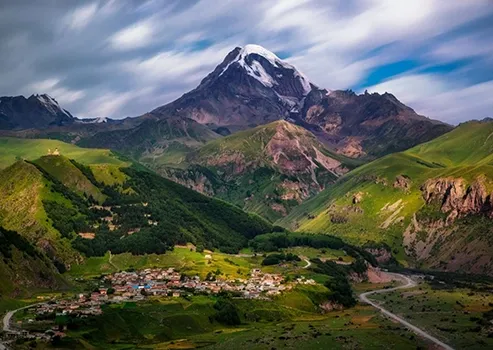
Georgia is located on the eastern shore of the Black Sea, in the geographical area known as the Caucasus — a mountainous country covering most of the Caucasus Mountain Range. In general, the country has 12 climate zones, including deserts and glaciers.
Georgia has several UNESCO World Heritage sites including towns such as Mtskheta (ancient capital) and Ushguli (a medieval tower city in Svaneti).
It is one of the best destinations for hikers, gastronomy lovers, and fans of traditional dance and polyphonic music.
Georgia is considered the cradle of wine — with an 8,000-year-old winemaking tradition. The country also holds the world's oldest thread (34,000 years old) and oldest golden mines (6,000 years old).

The name of the city comes from the Georgian word "Tbili", meaning warm. The city's citadel was established in the 3rd century AD.
Tbilisi is known for its narrow streets, balconies, and ancient buildings. It is a culinary muse — with Khinkali at the top of the list.
Hotels / hostels — 20–50 EUR. We recommend staying near the Old Town.
Transport — metro and buses are the main means of movement.
Museums close around 18:00.
Most restaurants close around 23:00.
Public transport runs until ~23:00; metro until midnight.
Some pubs operate till 02:00–03:00.
Oh, and one fine mug of beer costs around 2–3 EUR — and you can find it almost everywhere.
Visit Tbilisi ↗The club was established 4 years ago, covering mainly Longsword and Saber directions. It has its own training compound with an arsenal of different HEMA weapons.
Fencers from St. George School have participated in many international tournaments, winning all sorts of medals — proving themselves as competitive, skilled, and fair fencers.
St. George has solid experience in hosting and organizing international HEMA tournaments.

Visa & Documentation
In general, you can stay visa-free for a full year (365 days) in Georgia.
Documents required: valid passport + travel insurance (min. 30,000 GEL / ~9,000 EUR).
If your country is not visa-free, contact Georgian authorities via geoconsul.gov.ge — procedures are simple, often just an online form.
Insurance
Once you accept the tournament challenge (and hopefully you do!), start working on insurance paperwork.
Travel insurance is mandatory. Minimum coverage: 30,000 GEL (~9,000 EUR), covering health and accidents. You can bring insurance from your country or purchase it online from Georgian providers before arrival. Most Georgian providers support communication in English and can provide documents.
Insurance companies: Imedi L, TBC
Transport & City Card
Once in the city, buy a municipality card (0.8 EUR) — available at any metro station. It works on all public transport.
All info regarding fees, routes and schedules: ttc.com.ge
Download these apps on your phone: TTC (Tbilisi Transport Company), Bolt, WhatsApp, Telegram, and 112 Emergency.
Emergency number: 112 (hopefully you won't need it).
Getting to Tbilisi
Shota Rustaveli Airport is located 12 km east of Tbilisi. Three ways to reach the city:
Taxi — in front of the terminal. ~20–30 EUR, 20–25 min.
Bolt — order via app (EV only). ~10–20 EUR, 20–25 min. Note: cannot stop at airport for more than 2 min.
Bus №337 — Airport → Central Station. 0.3 EUR, every 25 min, 07:00–20:15, travel time 40–45 min. Stop is directly in front of the airport. Card & Google Pay accepted.